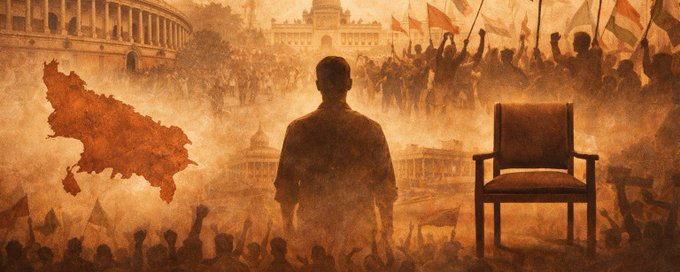
Uttar Pradesh has always been the political heartbeat of India. With the largest population and the highest number of parliamentary seats, the state not only shapes national narratives but also decides political destinies. Over the decades, Uttar Pradesh has demonstrated one clear truth: power in the state does not shift only through slogans or personalities—it shifts when social equations change.
For years, caste-based alliances formed the backbone of political success in Uttar Pradesh. Parties built their strategies around core vote banks—Dalits, OBCs, upper castes, and minorities. When these social combinations remained stable, political dominance remained intact. But the moment these equations started changing, power began to slip away.
One of the biggest lessons from Uttar Pradesh politics is that no social group remains permanently loyal. Aspirations evolve. Younger voters look beyond traditional caste identities and focus more on development, employment, governance, and dignity. When political parties fail to recognize this shift and continue relying on outdated social formulas, they slowly lose relevance.
Another important factor has been the fragmentation of vote banks. Earlier, communities voted in blocks. Today, internal divisions, regional identities, economic differences, and leadership perception influence voting behaviour. A single community no longer votes uniformly. This fragmentation weakens the traditional political arithmetic that once guaranteed victory.
Leadership credibility has also played a major role. Social alliances alone are not enough if voters feel leadership is disconnected from their daily struggles. In Uttar Pradesh, the parties that managed to combine social representation with strong governance narratives gained public trust. Those that relied only on identity politics without delivering results saw their support erode.
Development has emerged as a new social equalizer. Roads, electricity, law and order, welfare schemes, and infrastructure have reshaped voter priorities. When governance reaches villages and towns, it cuts across caste lines. Voters begin to compare performance instead of identity. This transition has significantly altered the traditional power equations in the state.
Communication strategy is another critical lesson. Social media, grassroots outreach, and narrative control now influence how communities perceive political intent. The party that successfully frames itself as inclusive and forward-looking manages to attract cross-caste support. Those that remain trapped in old messaging lose connection with the evolving electorate.
Uttar Pradesh also teaches that political arrogance can be costly. When leaders assume that certain communities will support them “no matter what,” they stop listening. Over time, dissatisfaction builds silently, and elections become the moment of expression. Power then shifts not suddenly, but as a result of years of accumulated disconnect.
The biggest takeaway from Uttar Pradesh politics is simple yet powerful: social equations are dynamic. They are shaped by aspiration, governance, identity, economic mobility, and leadership trust. Any political force that adapts to these shifts stays relevant. Those that resist change eventually drift away from power.
In the end, Uttar Pradesh is not just a battleground of parties—it is a mirror of India’s changing society. And the lesson is clear: political success no longer depends only on who represents which community, but on who understands how society itself is transforming.